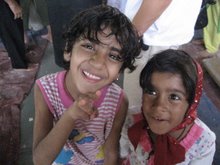
First, let me address a couple of comments. The food, Lianna, is amazing. I have enjoyed more delights than I could try to count, and even though I shy away from the spicy stuff, I am still able to enjoy a wide variety of foods. I know Mrs. Francis knows of a good Indian food place on S.I. ... I'll want to check it out when I get back. As for the Caste system: Yes, it still exists only in that some people in the former "untouchable" caste aren't getting access to the same education that others are. I think it is now more like the class system that we have at home, where the poor are getting poor-er because they aren't able to work their way out of it. I have also seen some domestic help (butlers, maids, etc) at schools being treated with little respect, though they are often the first to look us visitors in the eye. I have made sure to treat everyone equally ... and was thrilled to see a large group of children cleary from that group (you can tell the differences visualy most of the time) in a museum in Varanasi. It felt nice to see that they were learning about the history of India and had access to that experience. All in all, I'd say that although the System is legally gone, there is still a major difference in the way people are treated and certainly in how monies are allocated for education.
Back to my narrative: This morning we arrived by train (yes, it was a long ride; yes, it was a small bed; yes, we were delayed be several hours; yes, it was a WONDERFUL experience) in Kolkata. But before I tell of the city, I must talk of the train experience. The platform on which we sat was a cultural immersion unto itself: children sniffing glue and trying to sell fruit to passengers, security agents pushing people around with giant sticks, porters waiting for their tip as payment for moving the Americans' heavy bags, an oppressive and humid heat that made it hard to breath, the constant mutter of announcements in incomprehensible Hindi, the loud blaring of engine horns to indicate forthcoming movement, and the anticipation of an overnight ride that couldn't start too soon. We crowded into our air-conditioned slots and only felt cramped because our bags are so big. It was a peaceful ride, though, and I did sleep quite a bit. In fact we were lucky for the delay so we could see the rice fields and townships that we passed along the way this morning in the light of day. This truly is a beautiful country with a lot to offer.
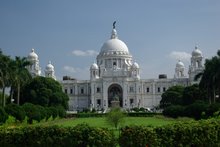
Now, for the new location. This city of intellect is bustling with people (is it possible it feels more crowded than the other two cities we've seen?). The first interesting fact I learned was that there are 60,000 taxis in this city ... can you imagine that? There are yellow cars (just like the ones in NYC) everywhere, and at least ten people on the sidewalk for every one of them. The short ride to the hotel showed a small portion of the city, including a fairly new bridge that floats on the water and is not secured to the ground in any way. Cool, huh?
This afternoon we met with teachers, a principal, and students, and enjoyed a lovely discussion about what the education system could be like, and what it's really like. I connected with each of the students and felt compelled to ask them a probing question (I know that surprises all of you to know that I put them on the spot and asked them to think!). They were each very bright and articulate and fed the hunger my brain is feeling for more knowledge about this place. They have all promised to email and stay in touch, as well as to write for the Insider (yahoo!).
I must tell you that I have heard more philosophies in the past few days that match the work we are trying to do than those that oppose it. I got a slew of books for our school, the staff, the students, myself, and anyone who is interested in how learning can help make the world a better place. It is still hard to look around and see that so many aren't getting access to it ... but there is good work being done by those who want to make a change in the world.
Wednesday, July 11, 2007

Monday, July 9, 2007
The City of Knowledge
Varanasi (also known as Baranas) is a center of studies and education, and so I have thought a lot about schools and visited a university where Ghandi addresses the Women's College in 1942. The city is also a religious center of this country because of the Hindu's belief in the holiness of the water in the Ganga (we call it the Ganges). They travel here from all around in order to bath in the waters. Yesterday I met a brilliant man who has studied the science of the river and started a non-government organization to try and clean it up because he realizes the dangers of the pollution ... but he is so devoted to his religion that he still bathes in it every day. He was the embodiment of the polarization of our world today: how can the logic of science co-exist with the passion of religion?
I continue to learn from what I see and hear on this trip. Yesterday included several hours of driving and walking so I got a chance to see what life is like for the people who live here. I have seen many children without enough clothes. I have seen many families crowded under a meager shelter waiting for food to arrive. I have been prodded by beggars near the river asking for money. I have been in the home of a young artist who does batik and weaves silk with his father. I have ridden on cycle-rickshaws through very crowded streets and been stared at like I was from another planet. I feel like that is how they see me .. and wonder if I am looking at them the same way or not.
Tonight we will take an overnight train to Kalkutta (Calcutta). I look forward to another adventure there and I know that I will have more questions and observations as we travel through this beautiful country.
I continue to learn from what I see and hear on this trip. Yesterday included several hours of driving and walking so I got a chance to see what life is like for the people who live here. I have seen many children without enough clothes. I have seen many families crowded under a meager shelter waiting for food to arrive. I have been prodded by beggars near the river asking for money. I have been in the home of a young artist who does batik and weaves silk with his father. I have ridden on cycle-rickshaws through very crowded streets and been stared at like I was from another planet. I feel like that is how they see me .. and wonder if I am looking at them the same way or not.
Tonight we will take an overnight train to Kalkutta (Calcutta). I look forward to another adventure there and I know that I will have more questions and observations as we travel through this beautiful country.
Saturday, July 7, 2007
Not Yet Enough Time to Reflect
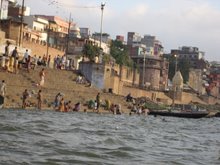
I am wanting to write so much ... again. This morning we awoke early to take a ride on the River Ganges. I am still groggy from the pre-dawn wake up call and need some time to process, but thought I'd share what I saw with all of you. The people there are so happy to be in the water, but I encourage all of you to research the cleanliness of the water and decide whether or not you would want to jump in.
I have many more things to tell you about Baranas, the second city on our journey, but I will wait until my mind is clear.
I have many more things to tell you about Baranas, the second city on our journey, but I will wait until my mind is clear.
Friday, July 6, 2007
So Much to Say
I have many things to tell you all, but won't try to do it in this forum. I'll save my journal writing and my notes to make sure I don't miss any details.
I had an incredible day visiting Mr Ajay's school where I was the guest of honor and was treated like royalty. I met some great teachers, the award-winning principal (nothing like what we do in the US, though), and a lot of amazing students. I got to teach a class and talk to another one, met with students who are writing articles for the International Insider, and teach Mr. Ajay how to use Geometer's Sketchpad. I spoke at the all school assembly (see picture at right) and talked with the math department about our different methodologies (though there were many similarities as well). It was a wonderful experience to see what a school here is like ... for example, my colleague and I walked into a room where a physics lesson was taking place; when we entered the teacher stopped what she was doing and left while the students got their math notebooks out and started taking notes. An interesting and quick transition.
I have so many things I've been thinking about ... philosophical things the value of which I don't want to diminish by rushing to write about. Today we had the amazing experience of being a panel of 16 American teachers to a room of 99 (no, I didn't count them all) Indian teachers convened from all over the country. They hit us with a lot of questions, some of which were tough to answer without starting a political debate. We got a lot of applause, though, especially when I mentioned that we all think Hindi should be taught in more schools in the US (Mrs. H, what do you think?). The event has got my mind spinning about what the real differences are between our two systems ... is it culture? philosophy? strategy? methodology? beliefs? I don't know yet, but I'll keep working on it.
Tomorrow we are off to a new city and a new phase of the adventure. Stay tuned!
I had an incredible day visiting Mr Ajay's school where I was the guest of honor and was treated like royalty. I met some great teachers, the award-winning principal (nothing like what we do in the US, though), and a lot of amazing students. I got to teach a class and talk to another one, met with students who are writing articles for the International Insider, and teach Mr. Ajay how to use Geometer's Sketchpad. I spoke at the all school assembly (see picture at right) and talked with the math department about our different methodologies (though there were many similarities as well). It was a wonderful experience to see what a school here is like ... for example, my colleague and I walked into a room where a physics lesson was taking place; when we entered the teacher stopped what she was doing and left while the students got their math notebooks out and started taking notes. An interesting and quick transition.
I have so many things I've been thinking about ... philosophical things the value of which I don't want to diminish by rushing to write about. Today we had the amazing experience of being a panel of 16 American teachers to a room of 99 (no, I didn't count them all) Indian teachers convened from all over the country. They hit us with a lot of questions, some of which were tough to answer without starting a political debate. We got a lot of applause, though, especially when I mentioned that we all think Hindi should be taught in more schools in the US (Mrs. H, what do you think?). The event has got my mind spinning about what the real differences are between our two systems ... is it culture? philosophy? strategy? methodology? beliefs? I don't know yet, but I'll keep working on it.
Tomorrow we are off to a new city and a new phase of the adventure. Stay tuned!
Wednesday, July 4, 2007
Happy Birthday, USA!
Feels silly, but this day feels just like any other day in India. We weren't invited to the US Embassy party tonight, so we're making our own here at the hotel. Should be nice, though we're all in for an early night since we'll get up early in the morning to go the schools of our cooperating teachers.
Mr. Ajay and I are excited to put together our project (and yes, Mrs. K, I have also been trying to get him and teachers from other schools to have students submit articles to the Insider, I've got your back). I have learned that the class size here is much larger than in the US (40 to 70) and that he doesn't use any technology at all (the students aren't even allowed to use calculators until they get the University level). His curriculum doesn't allow for group work or activities, though there is a national movement to include more of this. In fact, when we sat in the National Curriculum center yesterday we heard the latest political party line, which sounded a lot like a class from Trinity's MAT program ... all about learner centered instruction, etc. But we know that's not what is really happening here.
What is happening is a further division of the "Have's" and the "Have Not's". The poor students and village students don't go to school at all, certainly not past fifth grade. The girls (attn: GLI) are allowed to attend, but are often the first ones to drop out when their families need them. Only one in 100 girls who starts 1st class (our first grade) will finish 12 class, and even then she may or may not go on to University.
Tomorrow I will teach a small part of one or two classes, and hope to learn more about what the schools and students are like. So far I have met only kind and generous people, like the two teachers who helped me reach a bargain today when I bought some books for school. There are those sad faces begging for money around every corner, too, to remind you of how lucky you are, and to motivate you to enact far-spreading change in this damaged education system. They deserve to read children's books too.
Mr. Ajay and I are excited to put together our project (and yes, Mrs. K, I have also been trying to get him and teachers from other schools to have students submit articles to the Insider, I've got your back). I have learned that the class size here is much larger than in the US (40 to 70) and that he doesn't use any technology at all (the students aren't even allowed to use calculators until they get the University level). His curriculum doesn't allow for group work or activities, though there is a national movement to include more of this. In fact, when we sat in the National Curriculum center yesterday we heard the latest political party line, which sounded a lot like a class from Trinity's MAT program ... all about learner centered instruction, etc. But we know that's not what is really happening here.
What is happening is a further division of the "Have's" and the "Have Not's". The poor students and village students don't go to school at all, certainly not past fifth grade. The girls (attn: GLI) are allowed to attend, but are often the first ones to drop out when their families need them. Only one in 100 girls who starts 1st class (our first grade) will finish 12 class, and even then she may or may not go on to University.
Tomorrow I will teach a small part of one or two classes, and hope to learn more about what the schools and students are like. So far I have met only kind and generous people, like the two teachers who helped me reach a bargain today when I bought some books for school. There are those sad faces begging for money around every corner, too, to remind you of how lucky you are, and to motivate you to enact far-spreading change in this damaged education system. They deserve to read children's books too.
Tuesday, July 3, 2007
Making A Project Together
Today Mr. Ajay and I are working on our curriculum project. We will write up the plans for math projects that students in New York and in India will do, and then share.
Sunday, July 1, 2007
Learning Curve
I have been inspired to think of a great many things today, only some of which I will put before you to ponder.
We heard a lot today about the Education System in India and how they want to go through a renewal process to give a chance at an interesting education to ALL students (including the remote villagers). The drop out rates are tremendous. It saddens me to know that NYC has similarly dismal rates.
We talked about SOCIAL RESPONSIBILITY and the fact that Indian people haven't traditionally been brought up to feel any responsibilities to go with their fundamental rights. This helps explain why the 3rd richest man in the world, an Indian who lives in London, spent hundreds of millions of dollars on his daughter's wedding but doesn't donate any money to help people in his home country of India. There is some hope that the younger generations will understand their duty to help each other -- it reminds me of our service requirements and programs at school. We are lucky.
One speaker said it well when he explained that changing the education system will be: "... challenging, interesting, difficult ... possible." This speaks to my own educational philosophy and I appreciate his sense of hope.
There was much more (like the square being a common and almost holy image in Indian traditions because it is so perfect), but I will leave it at this for now. I will continue to think about how the US system IS serving students well by helping them become thoughtful, moral, engaged citizens, and how we can learn so much about the motivation and skills that drive highly dedicated Indian students to earn at least a 98.5% on the college entrance exam or else they won't get in (there aren't enough seats in colleges and universities to fit every student who graduates from Form 12, so a lot of them just don't get to go to school).
We heard a lot today about the Education System in India and how they want to go through a renewal process to give a chance at an interesting education to ALL students (including the remote villagers). The drop out rates are tremendous. It saddens me to know that NYC has similarly dismal rates.
We talked about SOCIAL RESPONSIBILITY and the fact that Indian people haven't traditionally been brought up to feel any responsibilities to go with their fundamental rights. This helps explain why the 3rd richest man in the world, an Indian who lives in London, spent hundreds of millions of dollars on his daughter's wedding but doesn't donate any money to help people in his home country of India. There is some hope that the younger generations will understand their duty to help each other -- it reminds me of our service requirements and programs at school. We are lucky.
One speaker said it well when he explained that changing the education system will be: "... challenging, interesting, difficult ... possible." This speaks to my own educational philosophy and I appreciate his sense of hope.
There was much more (like the square being a common and almost holy image in Indian traditions because it is so perfect), but I will leave it at this for now. I will continue to think about how the US system IS serving students well by helping them become thoughtful, moral, engaged citizens, and how we can learn so much about the motivation and skills that drive highly dedicated Indian students to earn at least a 98.5% on the college entrance exam or else they won't get in (there aren't enough seats in colleges and universities to fit every student who graduates from Form 12, so a lot of them just don't get to go to school).
Subscribe to:
Posts (Atom)