**Note: I am having some difficulty posting pictures, but have a few I will put up when I can.**
Today I witnessed some of the amazing beauty of the ancient city called Mahabalipuram. We wandered through four types of temples: those carved out of giant rock from the top down (which aren't completely hollow, so you can't go inside), those carved into caves (they used the natural hollowness and made intricate designs around every side), those carved into walls of rock (left to the elements of the weather in an open air setting), and those built from the ground up. It was humbling to step into a time very different from ours, to hear the stories of these idols and gods and how detailed the stories are that have been passed down for so long. I also saw what out tour guide claimed is the world's oldest known slide, probably used for play by children in the 6th century CE. There were lots of people there, and lots of people trying to sell us things, but it wasn't an uncomfortable situation at all. It was a pleasant, though very hot, way to glimpse a look at the past.
It was also near the beach, which was a nice change of pace. We all walked up to the water to stick our toes into the Bay of Bengal. The water was cold, which felt good considering the sun had been beating down on us all morning long. The best part was watching the other people, though, who could have been from any part of India -- some city in the north or just from Chennai. There were many families, though, clearly out for a Saturday adventure, enjoying the outdoors and the beauty of the ocean. The beach was different from the ones we are used to, though, as there were five or six ice cream selling carts that had been pushed out near the water (with a great deal of effort, I might add) and not one person in a bathing suit or in the water. The purpose of a trip to the beach is different here ... less about exposure and swimming and more about the event (seeing a body of water when many people in India rarely get to). I was glad we were able to participate.
This afternoon I met a lovely woman with a fantastic bookshop. She has been moved out of the hotel and into a tiny space next to the parking lot. The space is not wide enough for me to spread out my arms, and I wasn't even able to step in because she has thousands of books stacked up from floor to ceiling. I just glanced inside, but spent most of the time chatting with the owner (who named the store "Giggles" because her friend told her to open her own store just for giggles). She told me about herself, her love for Madras (she still refers to the city with this name), for India, for books, and for international relations. She has made me promise to stay in touch and contact her before anyone else in case we need any more books about India when I get home.
Meeting people in this country has been my favorite part of this trip. Talking with people on the streets, chatting with teachers in a school, and grilling students with questions about every aspect of their lives, I have learned what the people here are like. I wonder what sense of the United States people get when they come to our country, and if talking with the locals has the same value there that I have found it does in other countries I have visited.
Tomorrow we are off to Cochin ... and the body of water will be the Arabian Sea. Another phase of the adventure is awaiting!
Saturday, July 21, 2007

Friday, July 20, 2007
A Long Way to Go
That's not to say that I feel like we have a lot left in this trip ... in fact I can feel the end breathing down my neck. I can't believe we have less than two weeks left. In fact, I will repeat that we have a lot to learn, and as I told the reporter when I was interviewed for the news in Bhubaneswar, we would need more like 6 months or 6 years to see even part of what we can learn from here in India.
But there have been exciting moments over the last few days. Instead of re-capping them one-by-one, I think I'll tell you a little bit about what I've been noticing, thinking, and talking about since we arrived here in Chennai (formerly called "Madras").
As I rode home in an Auto-Rickshaw this evening, I realized that there are essentially two different economies co-existing here. One is the economy of a developing nation, where we paid the equivalent of $1.25 to get a ride over 15 minutes long. The second is that of a developed nation, where we are staying at a hotel that charges over $200 a night (I'm not sure of the exact price, it's not the kind of place where they put the nightly rate on the marquis out in front). There are two different worlds that exist even here ... and of course the rickshaw driver didn't know which of the two Taj chain hotels to bring us to, therefor taking us to the wrong one so we could enjoy a slight detour of the city. But they make it work, somehow, and we bargain over Rs. 100 as if it means something to take $2.50 off the price of a $10 shirt that in the U.S. we would pay $40 to own. And you wonder when the lagging economy will catch up with the other, and is that how a nation is labeled fully developed? It's all quite dizzying, really.
Earlier today we visited a Non-Government Organization that is doing some neat work with sustainable development, empowering women, and educating underprivileged children. It got me thinking about the ways people need help. In the US we are often very quick to offer money to those we see are in need. We write a check to the correct charity, send it in an envelope with a stamp showing the whole world (or at least the staff at the post office) that we care about making a difference, and then go back to our own lives. But I was reminded today that most people don't want to have help served to them ... they want to know how to help themselves. So these students have come to this place where they can learn to use computers even though their own school can't afford them. And these women are taking their own goods to market instead of waiting for the men to do it, and using the local (rural) technology center to find out if the weather will be good enough for fishing the next day. Service is a meaningful thing to be sure, but one must be an active donor in order to give the kind of help most often needed, I think.
Yesterday we visited the first Anglican Church in India, called St. Mary's, and this morning we saw the original tomb of on the Jesus' apostles. Both were beautiful to see, and yet they each felt surreal. I felt as if I was back in Italy, staring at the beautiful marble and gazing at gravestones from over one thousand years ago. It was a visible reminder of the way this country has grown largely because of (or maybe in spite of) an outside culture. That church was built by the British, and so were the streets with cars travelling on the left, and so were the restaurants that serve tea every couple of hours, and so were the schools that teach classes in English. So much of the culture of the place now called India was influenced by the British. But there are still tribal villages hidden in the hills and the central part of the country ... the ones known as "backward" according to many speakers I've heard while here. One can't walk around the corner in the cities we've seen and ignore the still constant presence of that European influence. I try to close my eyes and imagine it all if that one Indian king hadn't let the British lease that spot of land here in Chennai ... what would India have been like then ... would they still drink so much tea? ... would they have Christian churches? ... would they drive on the "right" side of the road?
But there have been exciting moments over the last few days. Instead of re-capping them one-by-one, I think I'll tell you a little bit about what I've been noticing, thinking, and talking about since we arrived here in Chennai (formerly called "Madras").
As I rode home in an Auto-Rickshaw this evening, I realized that there are essentially two different economies co-existing here. One is the economy of a developing nation, where we paid the equivalent of $1.25 to get a ride over 15 minutes long. The second is that of a developed nation, where we are staying at a hotel that charges over $200 a night (I'm not sure of the exact price, it's not the kind of place where they put the nightly rate on the marquis out in front). There are two different worlds that exist even here ... and of course the rickshaw driver didn't know which of the two Taj chain hotels to bring us to, therefor taking us to the wrong one so we could enjoy a slight detour of the city. But they make it work, somehow, and we bargain over Rs. 100 as if it means something to take $2.50 off the price of a $10 shirt that in the U.S. we would pay $40 to own. And you wonder when the lagging economy will catch up with the other, and is that how a nation is labeled fully developed? It's all quite dizzying, really.
Earlier today we visited a Non-Government Organization that is doing some neat work with sustainable development, empowering women, and educating underprivileged children. It got me thinking about the ways people need help. In the US we are often very quick to offer money to those we see are in need. We write a check to the correct charity, send it in an envelope with a stamp showing the whole world (or at least the staff at the post office) that we care about making a difference, and then go back to our own lives. But I was reminded today that most people don't want to have help served to them ... they want to know how to help themselves. So these students have come to this place where they can learn to use computers even though their own school can't afford them. And these women are taking their own goods to market instead of waiting for the men to do it, and using the local (rural) technology center to find out if the weather will be good enough for fishing the next day. Service is a meaningful thing to be sure, but one must be an active donor in order to give the kind of help most often needed, I think.
Yesterday we visited the first Anglican Church in India, called St. Mary's, and this morning we saw the original tomb of on the Jesus' apostles. Both were beautiful to see, and yet they each felt surreal. I felt as if I was back in Italy, staring at the beautiful marble and gazing at gravestones from over one thousand years ago. It was a visible reminder of the way this country has grown largely because of (or maybe in spite of) an outside culture. That church was built by the British, and so were the streets with cars travelling on the left, and so were the restaurants that serve tea every couple of hours, and so were the schools that teach classes in English. So much of the culture of the place now called India was influenced by the British. But there are still tribal villages hidden in the hills and the central part of the country ... the ones known as "backward" according to many speakers I've heard while here. One can't walk around the corner in the cities we've seen and ignore the still constant presence of that European influence. I try to close my eyes and imagine it all if that one Indian king hadn't let the British lease that spot of land here in Chennai ... what would India have been like then ... would they still drink so much tea? ... would they have Christian churches? ... would they drive on the "right" side of the road?
Wednesday, July 18, 2007
What's in a School?
This morning we visited two more schools and it occurred to me I haven't really shared the extraordinary things I am learning in these visits. It is important to remember, before trying to visualize one of these, that we are here as guests of the Indian Government and are sent by the US Government and are therefore, in many ways, treated "like royalty." That is not to say that we are ever, or ever could be so
deserving. It does, however, make me think about the way we greet visitors to our school and I think we could learn a thing or two from our Indian counterparts.
In every school we are welcomed by someone, either a committee of adults, of students, a color guard and choir, or the principal. We are usually then ushered into the conference room and given tea, coffee, or snacks. Then we introduce ourselves and hear introductions of the teachers and administrators involved, or sometimes we go straight to the all-school assembly (described in an earlier post) to introduce ourselves. We are often immediately taken on a tour -- sometimes as a large group (so we walk through the halls causing quite a stir, as it is really difficult to
ignore 16 Americans creeping through the halls) or we are split into smaller groups (this also gets us into trouble because then I get to go into a math class, and you all know what happens when I get to enter a math class: I start talking with children, doing problems, asking questions, etc). After the tour we return to the meeting room for "interactions." This is the time set aside by our hosts for talking,
either with students on a panel, with teachers, or both. This is ALWAYS accompanied with tea and snacks, and we are ALWAYS running late to this session because we get caught up in the hallways talking with students (I know, you're surprised). And then the conversations wane as we are told we must hurry to our next appointment. We slurp down our tea, are treated with special gifts (often a copy of the school's yearbook, which is like our Literary Magazine) and then we are shuffled back through the hallways for a group picture in front of the school.
I'm not sure why I thought this narration would be of any interest to you, but since this pattern of behavior has consumed my days since arriving here, I guess I thought you might want to be able to imagine what it is like.
The reality, though, is a bit different. This morning we saw a government school only for boys, 100 of which were picked up from a tribal village and live in hostels near the campus. The building was falling apart, the boys didn't speak English and for that reason didn't seem to understand the friendly nature of our visit. The library was the size of my closet and the principal had no helpers or gifts to give
us. It was a reality check in comparison to make of the fancy schools we visit.
In other words, there are students in this country that need our help to ensure they have a fair shot at a good education and a bright future just as badly as the ones back home.
deserving. It does, however, make me think about the way we greet visitors to our school and I think we could learn a thing or two from our Indian counterparts.
In every school we are welcomed by someone, either a committee of adults, of students, a color guard and choir, or the principal. We are usually then ushered into the conference room and given tea, coffee, or snacks. Then we introduce ourselves and hear introductions of the teachers and administrators involved, or sometimes we go straight to the all-school assembly (described in an earlier post) to introduce ourselves. We are often immediately taken on a tour -- sometimes as a large group (so we walk through the halls causing quite a stir, as it is really difficult to
ignore 16 Americans creeping through the halls) or we are split into smaller groups (this also gets us into trouble because then I get to go into a math class, and you all know what happens when I get to enter a math class: I start talking with children, doing problems, asking questions, etc). After the tour we return to the meeting room for "interactions." This is the time set aside by our hosts for talking,
either with students on a panel, with teachers, or both. This is ALWAYS accompanied with tea and snacks, and we are ALWAYS running late to this session because we get caught up in the hallways talking with students (I know, you're surprised). And then the conversations wane as we are told we must hurry to our next appointment. We slurp down our tea, are treated with special gifts (often a copy of the school's yearbook, which is like our Literary Magazine) and then we are shuffled back through the hallways for a group picture in front of the school.
I'm not sure why I thought this narration would be of any interest to you, but since this pattern of behavior has consumed my days since arriving here, I guess I thought you might want to be able to imagine what it is like.
The reality, though, is a bit different. This morning we saw a government school only for boys, 100 of which were picked up from a tribal village and live in hostels near the campus. The building was falling apart, the boys didn't speak English and for that reason didn't seem to understand the friendly nature of our visit. The library was the size of my closet and the principal had no helpers or gifts to give
us. It was a reality check in comparison to make of the fancy schools we visit.
In other words, there are students in this country that need our help to ensure they have a fair shot at a good education and a bright future just as badly as the ones back home.
Tuesday, July 17, 2007
Monsoon Season
The flood waters have started pouring, and the flood of information is keeping pace. The last couple of days have been a blur of meetings, school visits, and riding through town on a funky tourist bus (complete with brown-based upholstery and neon lights in the dashboard and out the windshield). We have been inundated with ideas and examples of what is happening here, with materials to explain procedures and lectures to detail policies. I am still learning, though I think the curve has slowed, if only because my brain is starting to get too full!
I would like to tell of the schools we've visited in this mystical town. This state capital has over 1000 temples and so it is a mecca for pilgrims from all over India, as well as from other parts of the world, from a number of different religions. We have barely had time to see much, though we've visited a few of the major ones. Today's was a magical experience: as the monsoon rains poured down I walked into a temple where a monk had candles lit, incense burning, and wanted to tell us all about the idols inside. I wasn't able to stay long, but felt suddenly peaceful and a sense of harmony in that place. It was lovely.
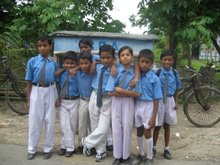
The schools we have visited are continuously impressive. Today's was a "public" (which means to us "private" since they are not funded by the government) school where students sang to us in Hindi, shared with us the food they'd cooked, asked us to teach them (a colleague of mine taught about the Russian Revolution -- his favorite topic), and talked with us about their thoughts on education systems (they highly recommend school uniforms, and have the impression that US schools have very few rules).
The most exciting experience, though, was the school founded by psychologists for students with disabilities. To see these students who are otherwise forgotten about learning to use computers, to bake and sell bread at the local market, making collages about the local festival, and laughing as we tried to dance with them ... it was a very special experience. I was happy to see that side of the work being done here, as much of our trip has focused on the privileged youth, the ones who are getting everything they need to survive AND the right to a good education. The children at this school were getting what they deserved, but what so many others cannot have. I was proud to be there to support them and the good work their teachers are doing.
I would like to tell of the schools we've visited in this mystical town. This state capital has over 1000 temples and so it is a mecca for pilgrims from all over India, as well as from other parts of the world, from a number of different religions. We have barely had time to see much, though we've visited a few of the major ones. Today's was a magical experience: as the monsoon rains poured down I walked into a temple where a monk had candles lit, incense burning, and wanted to tell us all about the idols inside. I wasn't able to stay long, but felt suddenly peaceful and a sense of harmony in that place. It was lovely.
The schools we have visited are continuously impressive. Today's was a "public" (which means to us "private" since they are not funded by the government) school where students sang to us in Hindi, shared with us the food they'd cooked, asked us to teach them (a colleague of mine taught about the Russian Revolution -- his favorite topic), and talked with us about their thoughts on education systems (they highly recommend school uniforms, and have the impression that US schools have very few rules).
The most exciting experience, though, was the school founded by psychologists for students with disabilities. To see these students who are otherwise forgotten about learning to use computers, to bake and sell bread at the local market, making collages about the local festival, and laughing as we tried to dance with them ... it was a very special experience. I was happy to see that side of the work being done here, as much of our trip has focused on the privileged youth, the ones who are getting everything they need to survive AND the right to a good education. The children at this school were getting what they deserved, but what so many others cannot have. I was proud to be there to support them and the good work their teachers are doing.
Monday, July 16, 2007
Unfair Comparison
Two roads diverged,
One thick with comfort – fluffed robes and room service, personal cars and the freedom of speech, of thought, of expression.
The other rich with culture – hundreds of languages, arts and tunes, dizzy with a wardrobe that wraps around your soul.
Two worlds,
Apart,
Distinct,
Unique,
But blending together as the globe around them shrinks.
A cell phone and a sari,
A blaring horn and a stubborn cow,
A holy temple and a public entrance fee,
A river and a right,
A hotel and it’s staff,
A school and a sacrifice,
A bargain and a steal,
A picture that could be worth a thousand words,
A cup of chai,
A dream, a wish, a hope.
The smiles that surround you are telling a story,
Of history and heroes,
Of sadness and belonging,
Of the future and the past,
Of families and fortresses,
And they’re also begging for your attention.
Don’t forget us, don’t ignore us, don’t shoo us away.
The air is thick with pollution, humidity, and the tension of uncertainty.
Will the people of this country every catch up with its growth spurt?
ALL the people
When will it be fully developed?
When, if ever, will we?
One thick with comfort – fluffed robes and room service, personal cars and the freedom of speech, of thought, of expression.
The other rich with culture – hundreds of languages, arts and tunes, dizzy with a wardrobe that wraps around your soul.
Two worlds,
Apart,
Distinct,
Unique,
But blending together as the globe around them shrinks.
A cell phone and a sari,
A blaring horn and a stubborn cow,
A holy temple and a public entrance fee,
A river and a right,
A hotel and it’s staff,
A school and a sacrifice,
A bargain and a steal,
A picture that could be worth a thousand words,
A cup of chai,
A dream, a wish, a hope.
The smiles that surround you are telling a story,
Of history and heroes,
Of sadness and belonging,
Of the future and the past,
Of families and fortresses,
And they’re also begging for your attention.
Don’t forget us, don’t ignore us, don’t shoo us away.
The air is thick with pollution, humidity, and the tension of uncertainty.
Will the people of this country every catch up with its growth spurt?
ALL the people
When will it be fully developed?
When, if ever, will we?
Sunday, July 15, 2007
Smiles are Worth more than a Thousand Words
Today we arrived in a new city: Bhubaneswar in the state of Orissa, on the coast south of Kolkata. I wasn't able to see much of the city yet, but can already feel the difference when in a town of only about 600,000 (rather than over 10 million). The people are, of course, very nice, and welcoming. Tonight we saw students dance the classical tribal dance in a recital at a local community center. The similarities between our cultures continue to grow on me.
I wanted to address Liana's comment from the other day, about whether or not the government is doing anything to help the "untouchables." I have mixed feelings about what I've learned and what I've seen in this area. My gut reaction is to say that from the LOOKS of things, the government is most interested in showing a strong and modern image to the world. It seems to be focusing it's resources on technology training, outsources to foreign companies, and the Indian Stock Market (which is a popular place to invest right now, from what I'm told). In the meantime, the PEOPLE seem to be the ones left behind. Because the rest of the world isn't looking in small villages, or along the sidewalks, or inside the shacks that make up the "slums" of the big cities, the government doesn't SEEM to be doing anything about it.
BUT, I will say that there is a growing sense of SOCIAL RESPONSIBILITY. We have visited several schools where community service is an integral part of the children's lives, and since schools are allowed to talk about religion and do prayers in school, there is also a sense of moral education going on. So there is a growth of concern for others, and every student I've talked with has a genuine interest in contributing something back to India (though some have different ideas of how they'll want to do that, through academic work, charity work, etc.). I am sure that there are members of the government who do CARE, and who are working hard to ensure that all citizens of this beautiful country are being treated fairly. I guess for me, it doesn't quite feel like it yet.
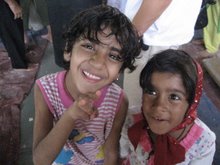
But the poor have strength in ways I think Americans can't really understand. I have never heard anyone complain here -- not the drivers who are cut off, the students who get only bread to eat at school, or the teachers who are reassigned to schools all across the country without the ability to refuse. The people here are very peaceful, content, and make the best of what they've got. The students we met in the village school yesterday were as kind as the ones from the private school the day before. And their smiles are just as contagious.
I wanted to address Liana's comment from the other day, about whether or not the government is doing anything to help the "untouchables." I have mixed feelings about what I've learned and what I've seen in this area. My gut reaction is to say that from the LOOKS of things, the government is most interested in showing a strong and modern image to the world. It seems to be focusing it's resources on technology training, outsources to foreign companies, and the Indian Stock Market (which is a popular place to invest right now, from what I'm told). In the meantime, the PEOPLE seem to be the ones left behind. Because the rest of the world isn't looking in small villages, or along the sidewalks, or inside the shacks that make up the "slums" of the big cities, the government doesn't SEEM to be doing anything about it.
BUT, I will say that there is a growing sense of SOCIAL RESPONSIBILITY. We have visited several schools where community service is an integral part of the children's lives, and since schools are allowed to talk about religion and do prayers in school, there is also a sense of moral education going on. So there is a growth of concern for others, and every student I've talked with has a genuine interest in contributing something back to India (though some have different ideas of how they'll want to do that, through academic work, charity work, etc.). I am sure that there are members of the government who do CARE, and who are working hard to ensure that all citizens of this beautiful country are being treated fairly. I guess for me, it doesn't quite feel like it yet.
But the poor have strength in ways I think Americans can't really understand. I have never heard anyone complain here -- not the drivers who are cut off, the students who get only bread to eat at school, or the teachers who are reassigned to schools all across the country without the ability to refuse. The people here are very peaceful, content, and make the best of what they've got. The students we met in the village school yesterday were as kind as the ones from the private school the day before. And their smiles are just as contagious.
Saturday, July 14, 2007
So Much to Learn
Over the past several days I have realized that there is a lot of stuff that I don't know. I don't know why we can't educate ALL the children in the same way we educate the children of the wealthy, and the ones who live in the right area of town. I don't understand why there isn't enough FOOD for the families I see living in the streets and sending the adorable toddlers up to Americans begging for money. I don't get how there can be so much wealth in the world and there are people dying every day. I don't know what to do about it.
I have also learned a lot. Yesterday we visited a school that works very hard to educate the whole child, and has an activity center that includes martial arts, mime, dance, music, and art to make sure the students appreciate their own culture. I learned that everywhere in the world there are people who understand the value of a well-rounded education. This morning we visited a school in a rural village where many of the students had never seen anyone from outside India before. I learned that one can communicate a lot of things without more than 20 words in any language in common. We sang "We Shall Overcome" with about 100 students today ... in a spontaneous gathering led by one of the students (who claimed not to know any English, by the way). It was fantastic!
Other things have been fun and interesting, but maybe only to me. I saw a Temple where there are daily sacrifices of a goat (and the smell of blood mixed with the heat and sweat was overwhelming). I myself have been so overheated and sweaty that I ruined a necklace because I didn't know the sweat could take the color out of the beads. My picture was in a local paper about our group's visit here (yes, mom, I have a copy for you). I visited a very sad Zoo where there were only a few animals and several of them were overheated and hungry (maybe it had something to do with the fact that we paid only 25 cents to get in). I have been harassed by shopowners who desperately want the Americans to visit their places of business, and it is clear how difficult times are around here. It surrounds you, envelopes you, suffocates you sometimes. Or maybe that's the pollution from the hundreds of thousands (if not millions) of cars. Or maybe just the heat.
I have also learned a lot. Yesterday we visited a school that works very hard to educate the whole child, and has an activity center that includes martial arts, mime, dance, music, and art to make sure the students appreciate their own culture. I learned that everywhere in the world there are people who understand the value of a well-rounded education. This morning we visited a school in a rural village where many of the students had never seen anyone from outside India before. I learned that one can communicate a lot of things without more than 20 words in any language in common. We sang "We Shall Overcome" with about 100 students today ... in a spontaneous gathering led by one of the students (who claimed not to know any English, by the way). It was fantastic!
Other things have been fun and interesting, but maybe only to me. I saw a Temple where there are daily sacrifices of a goat (and the smell of blood mixed with the heat and sweat was overwhelming). I myself have been so overheated and sweaty that I ruined a necklace because I didn't know the sweat could take the color out of the beads. My picture was in a local paper about our group's visit here (yes, mom, I have a copy for you). I visited a very sad Zoo where there were only a few animals and several of them were overheated and hungry (maybe it had something to do with the fact that we paid only 25 cents to get in). I have been harassed by shopowners who desperately want the Americans to visit their places of business, and it is clear how difficult times are around here. It surrounds you, envelopes you, suffocates you sometimes. Or maybe that's the pollution from the hundreds of thousands (if not millions) of cars. Or maybe just the heat.
Subscribe to:
Posts (Atom)